
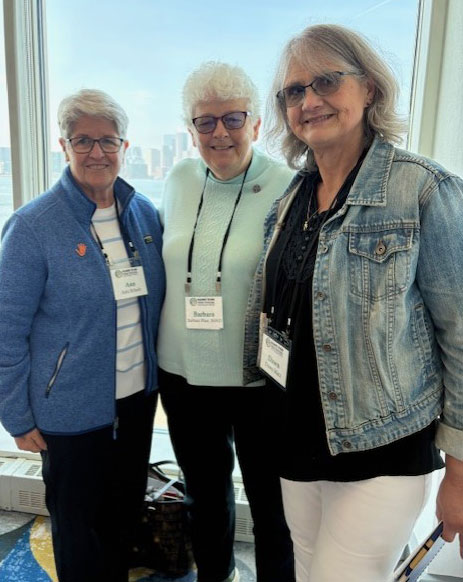
 Sister Ann Scholz, a founding member of the Alliance to End Human Trafficking Board; Sister Barb Pfarr, representative of the board of Sister House, an SSND-sponsored ministry; and Associate Dawn Martz, co-director of the SSND Central Pacific Province Associates, participated in the Alliance’s annual conference, April 14-17 in Boston. The gathering brought together a diverse group of 175 advocates, practitioners, and partners committed to strengthening human trafficking prevention efforts. The Atlantic-Midwest and Central Pacific Provinces of the School Sisters of Notre Dame served as sponsors of the conference.
“This was my first time attending a conference on human trafficking,” said Dawn. “It is scary how easily individuals, both adults and children, can get pulled into this life. We all need to get involved in advocating for those affected. Associates can get more involved in this and should. This affects all of us.”
Barb is also new to the work of the Alliance. “This conference was my first foray into human trafficking, and it scared me to death. The threat to my immigrant and low-wage worker friends and my great niece and nephew are exponentially greater now with the explosion of AI. My thanks to all our sisters and associates who have been doing this work for years. The hope is in education and political advocacy. Thankfully, we’re good at both, as well as in providing for the support of survivors,” said Barb.
Ann commented on the breadth of the program. “This year’s conference included survivors of labor and sex trafficking, those who accompany them in recovery, as well as professionals in the field of prevention. Speakers examined a range of issues from survivor-centered responses to the risks inherent in society. I was pleased to see that speakers emphasized both awareness and the need for coordinated prevention-focused strategies.”
In her opening remarks, Executive Director Katie Boller Gosewisch reflected on the foundation of this work: “The Alliance itself was born when a small group of committed women religious came together, recognizing that their individual efforts could become something far greater if united. Today, that vision has grown into a national network—hundreds of communities and congregations, coalitions, and individuals—standing together as a powerful voice for change.”