
In a recently published review article synthesizing over 30 years of work, Kyra Clarke highlights how the Nun Study has shaped the understanding of dementia. Key findings include the importance of early-life factors in influencing cognitive health decades later, the frequent presence of multiple brain pathologies contributing to dementia, and the observation that some individuals can maintain normal cognition despite having significant Alzheimer’s-related changes in the brain—a concept known as cognitive resilience. “A review like this is helpful because it brings together decades of findings into a single, accessible paper, allowing researchers and clinicians to better understand the study’s overall impact and identify important directions for future research,” said Clarke.
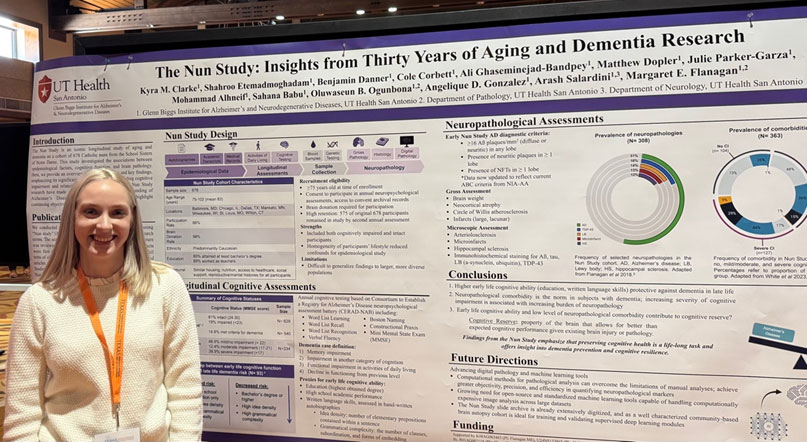 An MD-PhD student at UT Health San Antonio working on her dissertation under the mentorship of Nun Study Director Dr. Margaret Flanagan, Clarke is studying how multiple types of brain pathology contribute to cognitive decline. “In most individuals with dementia, it’s not just Alzheimer’s disease,” Clarke explains. “There are often coexisting conditions, particularly diseases affecting the brain’s blood vessels.”
Clarke’s research focuses on small blood vessels in the brain—how their structure changes with disease, and how those changes affect brain health and cognitive function. “Even small changes in these vessels can quietly damage the brain over time, increasing someone’s risk for dementia,” said Clarke. “By examining these structural changes in blood vessels and how they interact with Alzheimer’s disease, my goal is to better understand how vascular disease accelerates cognitive decline and to identify potential opportunities for earlier detection and targeted intervention.”
According to Clarke, one of the most exciting directions for the future of the Nun Study is the use of digital pathology. Turning traditional microscope slides into high-resolution digital images allows scientists to use computational tools to analyze brain tissue in ways not previously possible. This opens new possibilities for researchers. “Instead of looking at a few brain areas by hand, for example, we can now systematically analyze large sections of tissue and measure things like how many vessels there are, their size, and how healthy they appear,” said Clarke. “This helps us spot patterns of damage that might otherwise be missed and better understand how these changes relate to cognitive decline.” Ultimately, Clarke hopes to use these tools to identify structural features of blood vessels that could serve as early indicators of disease or targets for intervention, helping move the field toward earlier detection and more precise treatment strategies.
Advancements like these in dementia research would not have been possible without community-based, long-term studies like the Nun Study which allow researchers to follow people over time and connect changes in memory with physical changes in the brain. “What makes the Nun Study truly extraordinary is the level of commitment from the School Sisters of Notre Dame,” said Clarke. “Their level of participation reflects an incredible degree of generosity and dedication. Because of the sisters’ willingness to contribute, the Nun Study has supported decades of impactful research, with trainees like me continuing to build on this work today. It remains an active resource for ongoing neuropathological investigation and will continue to inform our understanding of dementia for years to come.”