
The way scientists study the brain is changing — and Dr. Margaret Flanagan, who directs the Nun Study, is helping lead the transformation with the help of brain tissue contributions by more than 600 School Sisters of Notre Dame.
For more than a century, pathologists have relied on microscopes and glass slides to examine brain tissue and uncover the causes of memory loss and dementia. Now, thanks to advances in technology, these slides can be digitally scanned into ultra-high–resolution images that can be shared instantly with researchers anywhere in the world. This growing field, called digital neuropathology, is modernizing how we study Alzheimer’s disease and other forms of dementia.
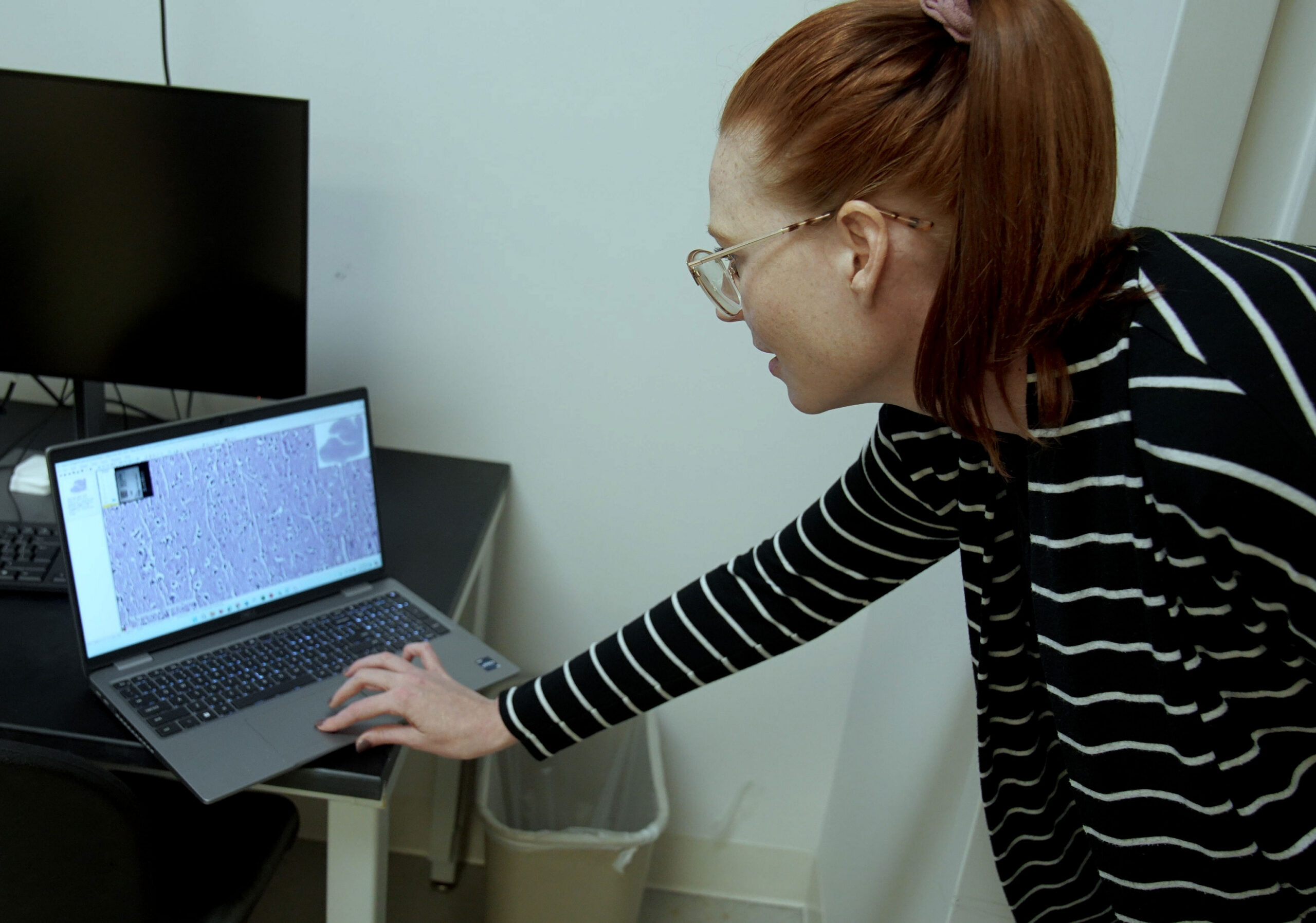
Dr. Flanagan and her collaborators across the country recently published a landmark paper in Alzheimer’s & Dementia, the journal of the Alzheimer’s Association. Their article, “Digital Neuropathology of Neurodegenerative Disorders: Foundations, Research Advances, and Future Directions,” highlights how digital imaging and artificial intelligence are allowing researchers to measure brain changes with greater accuracy and speed. The paper outlines how this technology can connect microscopic brain findings to genetics, imaging, and even blood tests—helping scientists detect disease earlier and understand why it progresses differently in each person.
A key part of this effort is the Brain Digital Slide Archive (BDSA), co-led by Dr. Flanagan and her team at the Glenn Biggs Institute at UT Health San Antonio. The BDSA is building a national library of digitized brain slides, creating a shared resource that allows scientists everywhere to collaborate on the same data. This initiative supports studies like the Nun Study, ensuring that the sisters’ remarkable contributions continue to inform global discoveries in brain health.
Through these efforts, Dr. Flanagan and her colleagues are helping build a future where every donated brain becomes a lasting source of learning—accelerating progress toward better diagnosis, treatment, and prevention of dementia.
“Digital pathology allows us to honor each donor’s gift by turning their contribution into data that can be shared globally, helping us learn faster and work together toward a world without Alzheimer’s,” said Dr. Flanagan.