
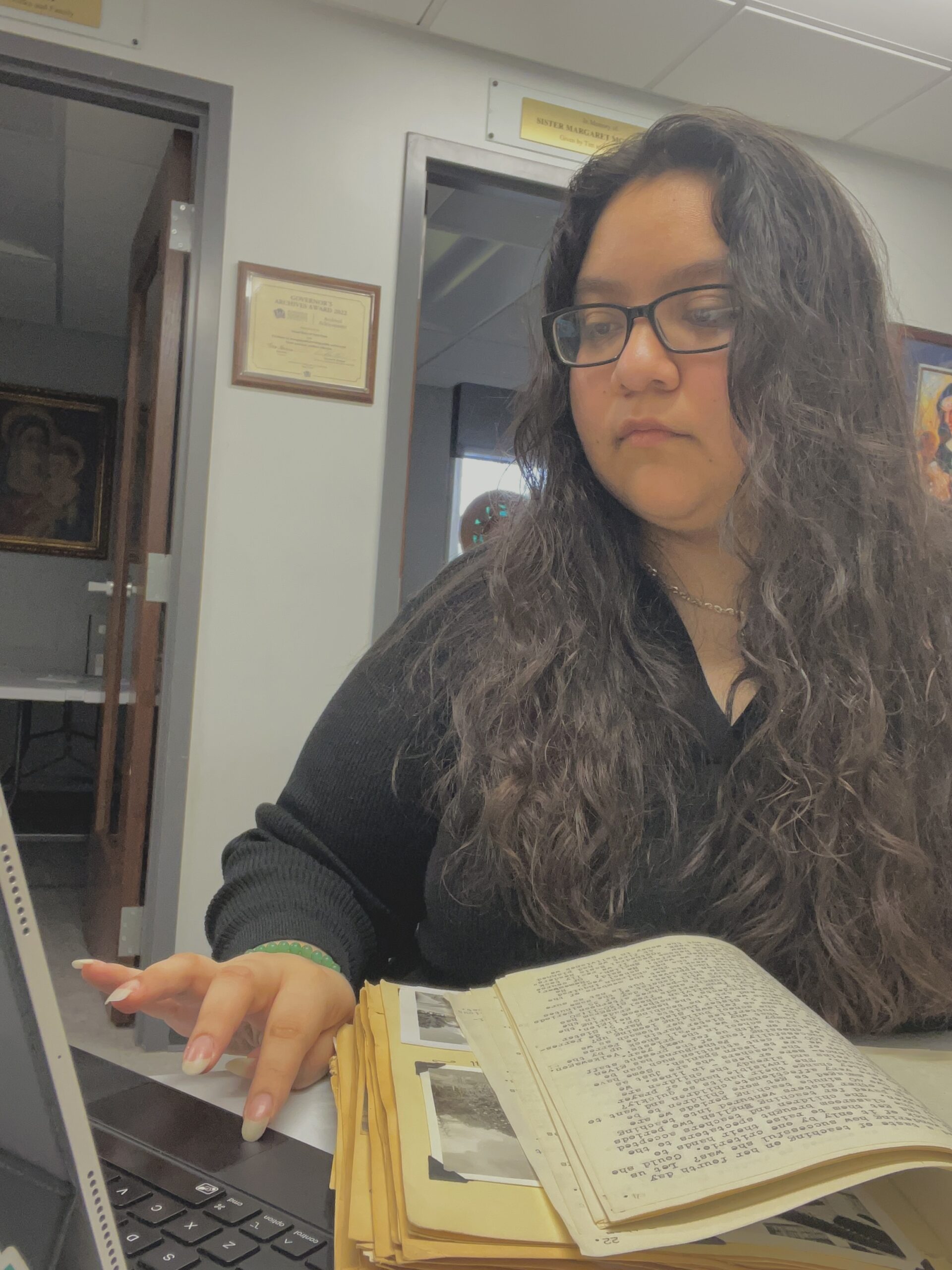
 As Lizbeth Reyes-Hernandez began planning for her senior year at SSND-sponsored Mount Mary University (MMU), her advisor suggested the SSND North American Archives as a possibility for an internship. A history major, Lizbeth had focused on Latin American and Indigenous communities and was very interested in women in leadership—an integral part of her experience at MMU.
“The first oral history I was assigned was that of Sister Alice Zachmann, who served in Guatemala,” said Lizbeth. “Listening to Sister Alice speak about her experiences left me in awe. I took it as a sign to continue with my focus on Latin American and Indigenous communities.”
Lizbeth’s project covers five oral histories—those of Sisters Alice Zachmann, Sister Martin de Porres Kimpel, Sister Francis Rose Rivers, Sister Carol Jean Dust, and Sister Janet Gregorchich. Lizbeth explored the ways the sisters adapted their missions in response to major historical events such as immigration waves, Vatican II, and political movements. To illustrate this, she created a visual timeline that highlights the connections between historical events and changes in the SSND’s mission. In addition, Lizbeth examined the intersection of gender, faith, and leadership as revealed in the sisters’ oral histories, creating an infographic depicting themes related to leadership challenges, gender expectations, and cultural dynamics.
“A major thread running through all five sisters’ stories is their deep commitment to serving marginalized communities in ways that respected cultural differences rather than erasing them,” said Lizbeth. “Each sister described learning from the people they served, whether through language, custom, or shared struggle, which reflects a leadership model grounded in humility rather than hierarchy.”
Another common theme Lizbeth discovered is the way faith informed the sisters’ courage in the face of violence or hardship, from Sister Alice surviving bombings and arrests in Guatemala to Sister Martin navigating political unrest in Bolivia. “All the sisters highlighted the importance of community solidarity, especially among women, who often became the driving force behind local change,” said Lizbeth.
Lizbeth also pointed to sisters’ adaptability, whether in responding to Vatican II reforms, political revolutions, immigration shifts, or new forms of workplace ministry. “Each sister demonstrated leadership that was relational, community-centered, and attentive to the emotional and spiritual needs of the people around them. The sisters often acted as bridges—between white and Mexican parishioners, between Indigenous and non-Indigenous communities, or between factory workers and institutions that often overlooked them.”
Overall, the sisters’ stories reveal a consistent pattern of leadership shaped by faith, cultural awareness, and unwavering commitment to justice. “I am deeply inspired by the School Sisters of Notre Dame and the work they have carried out for generations,” said Lizbeth. “I hope the sisters know how meaningful their journeys are and that their legacies of love and leadership will live on through those they have served and through students like me.”